Zifan Wang
Ph.D. student at KTH Royal Institute of Technology

KTH Royal Institute of Technology
Stockholm, Sweden
I am a fourth-year Ph.D. student affiliated with Division of Decision and Control Systems (DCS) at KTH Royal Institute of Technology. I am fortunate to jointly work with Prof. Karl H. Johansson at KTH and Prof. Michael M. Zavlanos at Duke University.
From January to April 2026, I was visiting Learning & Adaptive Systems Group at ETH Zurich, hosted by Prof. Andreas Krause. Prior to my PhD, I received both the master and bachelor degrees at Honors School of Harbin Institute of Technology.
My research centers on optimization over probability distributions, at the intersection of control, optimization, and generative modeling. This perspective has carried me from control and optimal transport through robust, risk-sensitive learning, and now to steering generative models. My goal is to develop the mathematical and algorithmic foundations for controllable and efficient generative-model steering, and to translate these advances into applications in scientific discovery.
Methods in Decision-Making
I develop distributional learning and optimization methods for decision-making.
Risk-Averse Learning
Distributionally Robust OPT
Distributional RL
Decision-Dependent OPT
Game-Theoretic Learning
Methods in Generative Modeling
I also develop methods for adapting and steering generative models.
Risk-Sensitive Fine-Tuning
Inference-Time Guidance
Federated Generative Models
Constrained Generative Models
- CCFO (coming soon)
Robust generation under distribution shifts
- GDRGO (coming soon)
Applications
Some selected applications include
Scientific Discovery
- Tail-Aware Flow Fine-Tuning
- CCFO
- GDRGO
Image Generation
Robotics & Transportation
news
| May 04, 2026 | Travel grant from Signeuls Foundation |
|---|---|
| Apr 22, 2026 | Two papers accepted at IFAC WC 2026! |
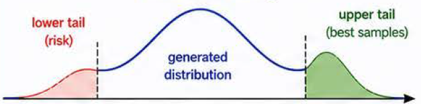
| Apr 15, 2026 | One paper on Tail-aware Flow Fine-Tuning (TFFT) accepted at ICML 2026! TFFT is a risk-sensitive generative optimization method that allows to efficiently seek novel samples (in molecular design) and control worst cases (in text-to-image generation)! |
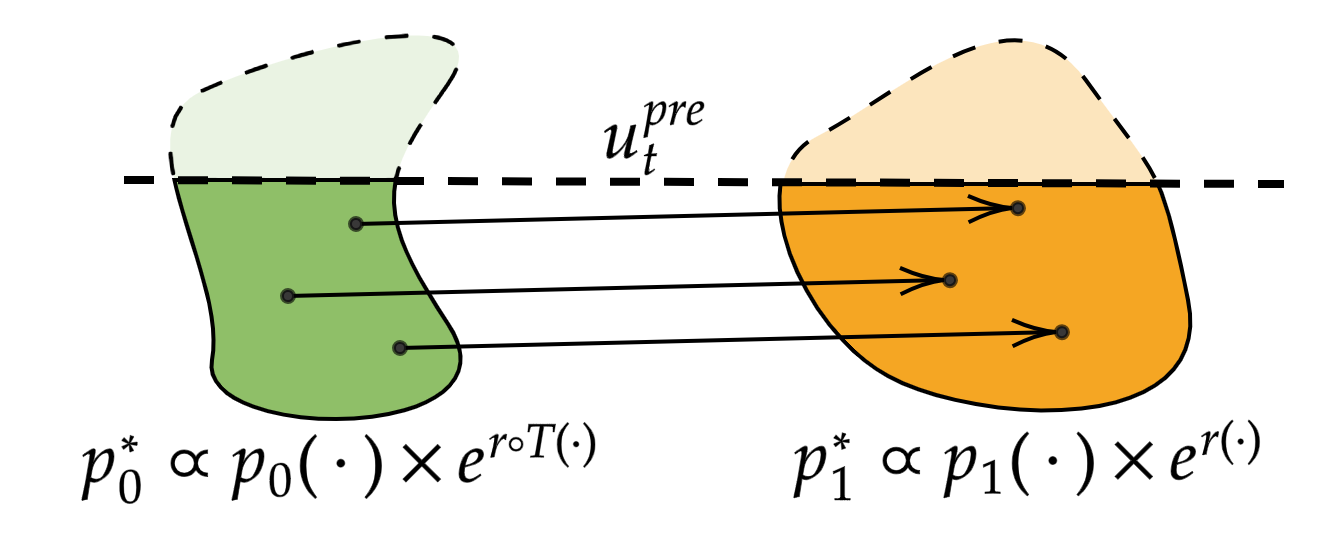
| Feb 24, 2026 | One paper on Source-Guided Flow Matching (SGFM) accepted at ICLR 2026! SGFM is a new flow guidance method that modifies the source distribution! |
| Jun 13, 2025 | I give a talk at ECC workshop in Thessaloniki, Greece |
selected publications
- NeurIPS
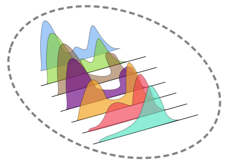 Outlier-robust distributionally robust optimization via unbalanced optimal transportIn Advances in Neural Information Processing Systems, 2024